Weaver
Weaver is a local-first AI translation workspace designed for long-form Japanese light novel translation. The project was built to support translation as a structured workflow rather than a sequence of isolated prompts, with a focus on maintaining context, terminology consistency, and project state across novels, volumes, and chapters.
Background
Translating long-form narrative content such as Japanese light novels introduces workflow problems that are not well handled by generic AI chat interfaces. While large language models can generate translations quickly, the surrounding process becomes difficult to manage once the scope expands beyond a few passages.
In practice, long-form translation requires more than a prompt box. Translators need to preserve terminology across chapters, keep character names and speech styles consistent, reuse previous translations, review output in context, and manage repeated iterations over the same source material. When these tasks are handled through disconnected notes, spreadsheets, and chat sessions, project state becomes fragmented and quality control becomes increasingly manual.
Weaver was built to address that operational gap. The goal of the project was to provide a dedicated translation environment where AI-assisted translation could be managed as a persistent, chapter-based workflow with supporting systems for terminology, context reuse, and batch processing.
What the project does
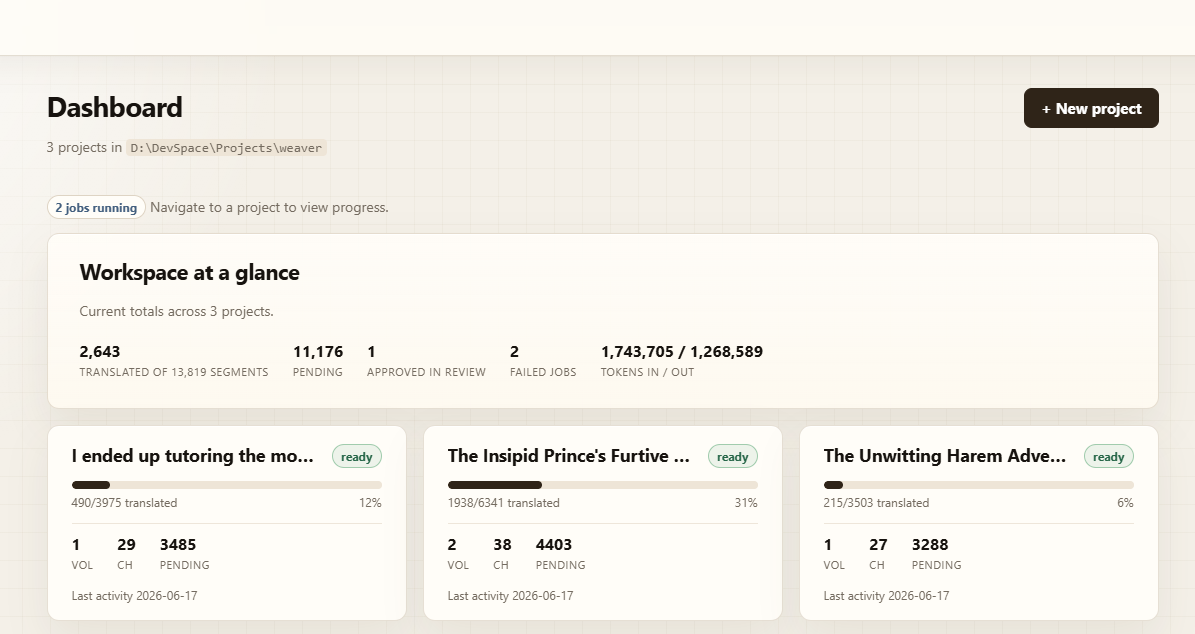
Weaver acts as a translation workspace for managing the end-to-end lifecycle of a light novel translation project. Instead of treating each translation request as an isolated interaction, the system organizes work around novels, volumes, and chapters, then connects those units to shared translation resources and AI execution workflows.
The platform supports the management of source content, translated outputs, terminology references, character information, and reusable translation history within a single local-first application. This makes it possible to revisit previous chapters, re-run translation flows, refine outputs, and export completed work without losing the surrounding project context.
At a high level, Weaver combines several responsibilities in one environment:
- project and chapter management for long-form translation work
- AI-assisted translation workflows across multiple providers
- translation memory for reuse of previous outputs and phrasing
- glossary and terminology management for consistency
- character databases for names, roles, and contextual notes
- batch translation operations for processing large volumes of content
- export pipelines for producing usable translation outputs outside the app
What I built
I built Weaver as a local-first translation platform with a workflow-oriented architecture rather than a single-purpose translation interface. The implementation focused on turning translation into a repeatable project workflow where context and supporting data remain attached to the content being translated.
The system includes structured management for novels, volumes, and chapters so that translation tasks can be tracked at the same level as the source material itself. On top of that project structure, I added the translation systems needed to support long-form consistency:
- a translation workspace for handling chapter-level translation tasks
- integration with multiple AI providers so workflows are not tied to a single model or vendor
- glossary injection and terminology support to reduce drift in translated terms
- character databases to preserve information about names, aliases, roles, and other recurring context
- translation memory mechanisms to reuse existing translations and maintain consistency across repeated phrases or patterns
- batch processing flows for translating multiple chapters or segments in sequence
- export workflows for moving completed translations into publication or editing pipelines
The goal was to make translation outputs part of a larger managed system instead of leaving them as disconnected model responses.
System design and workflow structure
A major part of Weaver was designing the application around persistent workflow state. Translation projects often involve repeated cycles of translating, reviewing, refining, and sometimes retranslating the same material with updated prompts, models, or terminology references. Because of that, the system needed to preserve not only the current translation output, but also the surrounding context that explains how and why that output was produced.
The workflow was therefore designed around several core ideas:
1. Project-based organization
Translation work is organized around novels, volumes, and chapters rather than around independent prompt sessions. This gives the project a stable structure and makes it easier to navigate large bodies of content over time.
2. Shared translation context
Glossaries, character references, and translation memory are treated as reusable project assets rather than one-off notes. This helps reduce terminology drift and makes it easier to keep translation choices consistent across chapters.
3. Provider-agnostic AI orchestration
Different models and providers can behave differently in terms of quality, style, latency, and cost. Weaver was designed so that translation workflows could operate across multiple providers instead of depending on a single model path. This makes experimentation and iteration easier, especially when evaluating outputs for different chapter types or editing stages.
4. Iterative translation workflows
The application is structured around the reality that a translation is rarely finished in one pass. A chapter may need to be translated, reviewed, refined, retranslated with different settings, and exported later. The workflow therefore needs to preserve enough context to support those repeated passes without forcing the user to reconstruct everything manually.
5. Local-first workflow control
Because translation projects can be large, long-running, and sensitive to context loss, the application was designed with a local-first orientation. This keeps the workspace close to the user’s own environment and supports project continuity without depending entirely on an online document-style workflow.
Technical focus
The most important engineering challenge in Weaver was not simply connecting to language models. The more difficult part was designing a system that could maintain translation consistency across an entire book-length project while still remaining usable as day-to-day software.
That led to several technical priorities during development:
- structuring data models around novels, volumes, chapters, glossary entries, character records, and translation history
- designing translation workflows that could preserve context between runs rather than treating each generation as stateless
- building reusable translation memory and glossary mechanisms that could be injected back into later tasks
- supporting batch operations without turning the workflow into a black box that is difficult to inspect or correct
- keeping the system flexible enough to work with multiple providers while maintaining a unified project workflow
From a product and engineering perspective, Weaver is less about raw text generation and more about managing the operational layer around text generation.
Current scope
The current implementation covers the core infrastructure required for a dedicated AI-assisted light novel translation workspace, including:
- novel, volume, and chapter management
- AI-assisted translation workflows
- multi-provider model support
- glossary and terminology management
- character database support
- translation memory reuse
- batch translation operations
- export pipelines for downstream use
The project evolved through multiple development iterations focused on improving workflow reliability, reducing manual translation overhead, and making the system more usable for long-form content rather than short prompt-based tasks.
Outcome
The result is a working translation platform that centralizes long-form AI-assisted translation into one local-first environment. Instead of splitting translation work across chat sessions, notes, spreadsheets, and separate tools, Weaver provides a single workspace where source material, terminology references, translation outputs, and workflow state can be managed together.
In practical terms, the project demonstrates how AI translation becomes significantly more useful when it is embedded inside a structured workflow system rather than exposed only as a standalone chat interface.
Key takeaway
The main lesson from building Weaver was that model output quality is only one part of the translation problem. For long-form content such as light novels, the larger challenge is workflow design: preserving context, managing terminology, tracking project state, and making iterative translation manageable across an entire book.
A strong translation workflow depends not only on the model being used, but on whether the surrounding system can keep the project coherent from the first chapter to the last.